
Centro internazionale Helder Camara > Stories > Insights > Uncategorized > Interview with Charles Edward Tamba, Archbishop of Freetown
Interview with Charles Edward Tamba, Archbishop of Freetown
Charles Edward Tamba, 65, was consacrated Archibishop of Freetown, capital of Sierra Leone, in 2008. In his religious and cultural journey, he studied twice in Rome: in June 1985 the Pontifical Urban University for Theological studies awarded him a Bachelor in Sacred Theology and in June 1991 he left again Sierra Leone to pursue a Licentiate and later a Doctorate degree in Dogmatic Theology at the Pontifical Gregorian University in Rome.
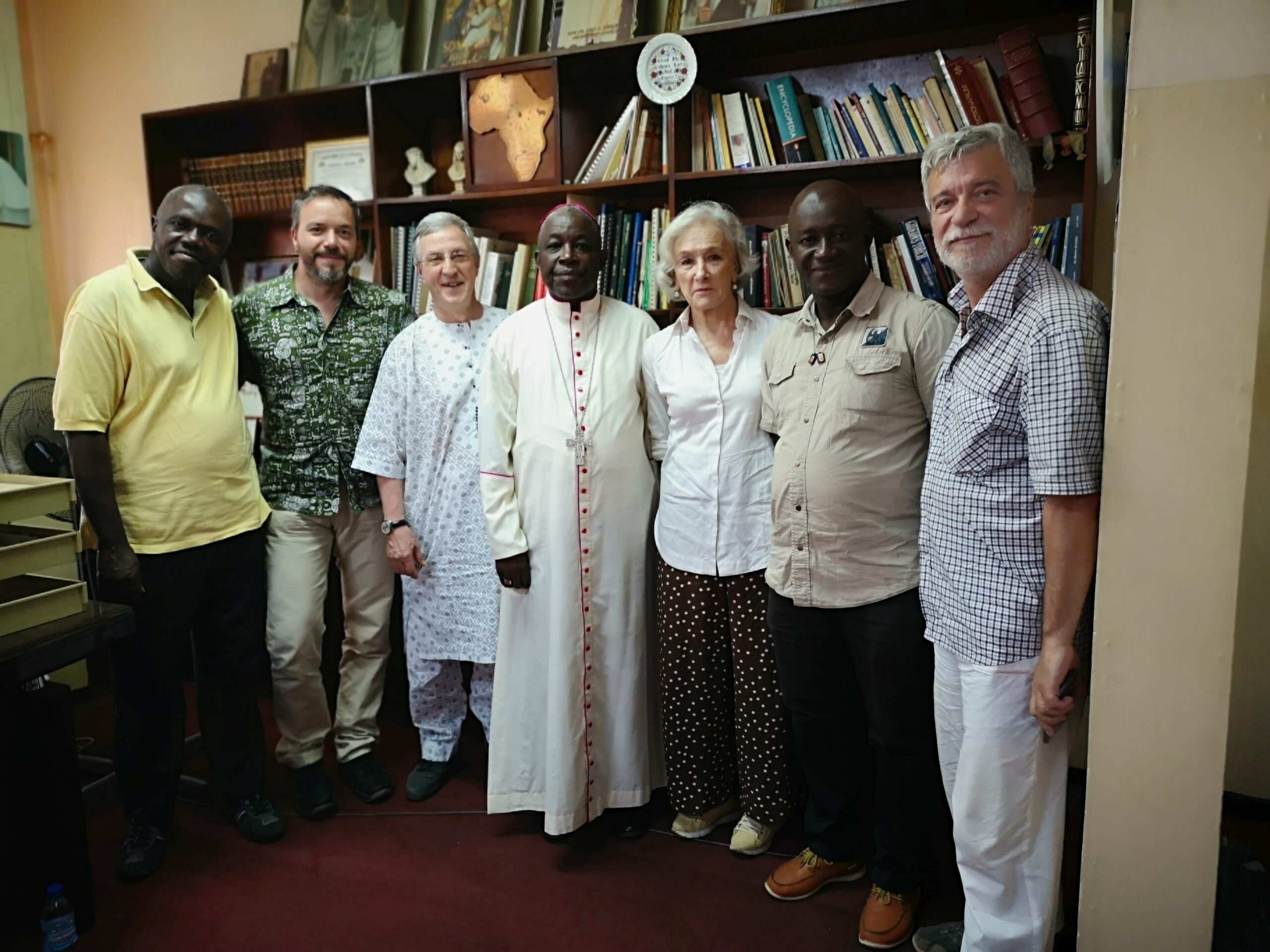
A delegation of Heldel Camara Centre – while visiting the country to check the implementation status of the projects and to express closeness to the brave population – met with him in January 2020 in his Archibishop palace. We were on the eve of the outbreak of the Covid19 pandemic. But we couldn’t know it. He came to greet us with his best smile. Gathered around a table, we talked for a long time, asking him about the relations with Islam and the commitment to safeguarding Creation.
Now that we are publishing the interview, we felt the need to update the news from Sierra Leone (november 2020) , because Covid has changed everything – our lives and theirs.
What is the COVID-19 situation in Sierra Leone?
Here is the COVID-19 status update, published on 12th November 2020: 1 registered confirmed case, total confirmed cases: 2,387; total number of deaths: 74; recovered: 1,816; total in quarantine: 108; total number discharged from quarantine: 12,043 (Source: NACOVERC Media Update on 12th November 2020: www.mic.gov.sl; www.dhse.gov.sl) .In light of the figures mentioned above, Sierra Leone is experiencing these days a noticeable decline in the rate of COVID-19 infections. As a result of this encouraging positive development in the fight against COVID-19, the Government has permitted religious houses to extend the duration of their worship time from two hours to 180 minutes (3 hours), if they so desire. The night curfew, which had already been reduced from 11 pm to 6 am, has now been lifted for a period of four weeks, after which the situation will be reviewed. However, the NACOVERC press release strongly advised continuous adherence to social distancing, wearing of face masks in public places, frequent hand-washing and other health measures meant to prevent infection by the virus, because the pandemic is not yet under total control throughout the world.
How are you facing the pandemic?
For a long time, Sierra Leone did not have a single case of COVID-19 infection, even as the neighbouring countries were reporting many cases. However, the Government did not sit by idly. Even before the first case of COVID-19 was reported in Sierra Leone towards the end of March 2020, the Government had already started sensitizing the people about the virus, its modes of transmission, signs and symptoms of infection, and how to protect oneself from infection. As a result, when the first case of infection was reported, we already knew what to do in order to protect ourselves. Public gatherings were banned and religious places were closed. As a result, we had to broadcast the Mass on Radio Maria. We also used the opportunity to continue to sensitize our people about the virus, its modes of transmission and how to protect oneself from being infected. We also advised our faithful to observe the measures put in place to contain the spread of the virus; such as frequent hand-washing, use of alcohol-based sanitizers, wearing of face masks in public places, avoiding physical contacts, and prompting seeking medical assistance whenever one begins to experience the usual symptoms of the virus.
During the pick of the outbreak of COVID-19 here – that is, from April to August 2020 – I worked from home and I only went to town on Sundays and major feast-days to celebrate Mass in the Cathedral that was streamed by Radio Maria for our faithful in Sierra Leone and in other parts of the world. The stay at home was sometimes very depressing, but I managed it by praying, exercising, reading more books, and watches movies on Netflix.
How are the authorities acting to slow down the spread of the disease?
Even before the first case of COVID-19, the Government started sensitizing the population about the virus, how it spreads from person to person, and what to do protect oneself from being infected. As the infections cases increased, the Government set up a National COVID-19 Emergency Response Centre (NACOVERC), to coordinate the national response to the pandemic as it developed. At some point, the national borders were closed and inter-district travels were banned, with the exception of transportation of essential goods. At a certain moment, there was a total lockdown for two weeks. Only people with passes were permitted to drive around the city or from one town to another.
Is the population suffering so much?
Naturally, the outbreak of COVID-19 caused and continues to cause so much suffering among the people in Sierra Leone. Offices, schools and commercial institutions were forced to close for a long time. The Ministry of Education organized the broadcast of teaching programmes on radio and TV. The universities and colleges organized lectures by internet. Unfortunately, not everybody could access them; they were either not available in some parts of the city, Freetown, or the signals were very poor. With the closure of business centres, many lost their jobs, thereby further increasing the rate of unemployment in the country. The pandemic has also affected the inflow of financial remittances from Sierra Leoneans in the diaspora, especially in Europe and America, because the pandemic caused loss of jobs and even deaths in those areas as well. For example, a cousin of mine, a nurse in London and a major bread winner for his family here in Sierra Leone, died of the virus in April and was buried there. All of these have impacted negatively our already struggling economy of Sierra Leone.
Was the experience of Ebola useful in facing the new pandemic?
Certainly, the experience of the Ebola pandemic here (from 2014 to 2015) was very useful in the containment of the spread of COVID-19. The people already knew the importance of personal hygiene, like frequent hand-washing and use of alcohol based sanitizers, avoidance of physical contacts, social distancing. The new element introduced is the wearing of face masks in public places.
The Government also fell back on the experience of the fight against Ebola here from 2014 to 2015 to organise a robust response to the COVID-19 outbreak. Thanks to the coordinated response to the outbreak, the early awareness raising and community, strict airport monitoring for in-coming and outgoing passengers, the coherent leadership by all those who were put in charge of the response, and the willingness of the population to cooperate with the measures put in place to contain the spread of the virus, inconvenient as they were, we are now experiencing some respite. We know that the pandemic is not yet completely over, but we are grateful to God for the noticeable reduction in COVID-19 infections in the country at this moment.
Archibishop Tamba, Sierra Leone has been for decades a positive example of good interreligious relations, but in recent years though some problems have risen between Christians and sectors of Muslim world. How would you describe the situation?
Well, in short I would say that the situation is very good, the relations are very good. Religious leaders of the two communities are personally involved in keeping high this level of relations and raise awareness among their faithful people. Thanks to this, we’ve been able to intervene positively when problems come. For instance, during the Ebola crisis we worked together to influence positively the policies of central government to contain the spread of the pandemic. Christian Churches, not only Catholic Church, have organized their own relief programs, for food and medicine, but we’ve done it together with Muslim organizations. And for animation, Muslims come to churches to talk about what to do during the pandemic and Christians go to the mosques, in order to give a unique message.
But do people listen to you?
In this country people are more likely to listen to religious leaders than to politicians, because they know we are not looking for their votes and then that we speak the truth about what is happening and they respect us. And therefore on Friday’s prayer in the mosques or on Sunday’s mass in the churches you have a broad spectrum of political affiliation and so we know that when we talk to them they are very sensitive. When we celebrate in the Cathedral and we ask for respect of others and others’ ideas, they understand that we refer to the Word of God and that the relation between our faiths has a decisive impact on the relationship with other people. And they respect us. And this works also at a network level. For instance I can sit here and communicate with the whole country through other bishops, and they are in in contact with the priests all over the country. An effective communication.
All right then?
That said, we are also paying attention to the developments of the situation, because there are aspects to worry about. One is jihadist movement which is very active in the Sahel region, in countries with which in the past we enjoyed good relationship, such as Mali, Niger, Chad. We had attacks from the jihadists and we fear that we will be the next prey… You know, they clearly say that they want to Islamize the whole West Africa. So while we enjoy religious tolerance, here and now, we should prepare ourselves to protect ourselves. Those of us who are older can notice the difference compared to twenty years ago, when there was a different Islam, when it was normal for Christian and Muslim kids to be educated together in the same school… Now Muslims are setting their own schools… The teachers come from Pakistan, where there is no respect for religious minorities. In Kalaba town, in the north, they tell me that is under construction the largest mosque in Sierra Leone…
What can you do?
In our Interreligious Council we have discussed a Code of Conduct: when you preach the Gospel or Muslim precepts, you must respect traditions and sensibilities, you should respect and promote religious freedom and tolerance which we presently enjoy, and not destroy all this. Few years ago we had a big trouble: there was a visit from a mufti from Tanzania and they had a big rally at the stadium and in that occasion false news were propagated about Sierra Leone and its rulers, the president and others… You cannot mix religion and lies… Take advantage of unemployed young people… We must be vigilant, together Christian and Muslims.
Now I would like to move to another topic, the ecological risks to which the entire planet is exposed. Pope Francis, especially in the encyclicals “Laudato si’” and “Fratres Omnes” never stops denouncing the distorted and unjust growth of world economy which is causing serious disasters: exploitation of the land, depletion of water resources, economy of waste… What do you think about all this?
”Laudato si’” is unique in many aspects. Coming to the situation in Africa, raising awareness is absolutely important and urgent… People just don’t understand that the plastic thrown on the road or on the beaches is awful… It’s very sad… When the rain comes, everything is dragged into the sea and the fish die… Every year we organize the collection of waste to raise awareness among the population. From this point of view the Encyclical can really become the occasion for a change of mentality. It must also stop the habit of indiscriminate fires under the pretext of burning waste… It is necessary to go to separate collection…
Are there any other serious situations that you would like to report?
Of course! We also have a big problem with mining. There is little control and the mines disfigure the landscape and produce sewage, and people who work there are not only exploited but are in danger of getting seriously ill… Chinese companies dig the mountains in search of gold… And then there is the indiscriminate felling of tall trees, always carried out by Chinese companies that export wood for furniture… Our forests are at risk of destruction. Of course, those companies employ many people, but this happens without guarantees for the future of our land. And this is clearly contrary to the principles of the Social Thought of the Church.
Argomenti trattati:
#Africa #Archbishop #Charles Edward Tamba #Freetown #Sierra Leone